


Calendar Year vs. Fiscal Year: Which Is Best for Your Business?

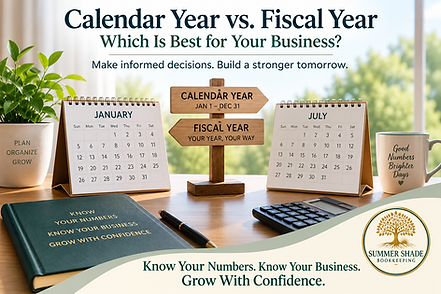
If you're a business owner, you've probably heard the terms calendar year, fiscal year, tax year, cash basis, and accrual basis accounting. You may even use some of them yourself without being completely sure what they mean or how they relate to one another.
And if you've ever wondered whether your business should simply follow January through December or whether another year-end might make more sense, you're asking an important question.
Your business's year-end affects how you organize and report your financial activity, how you review your business's performance, and how your financial records are prepared for your tax professional. For some businesses, December 31 makes perfect sense. For others, a different fiscal year-end may better reflect the way the business actually operates.
But there's an important distinction to understand first:
Your fiscal year and your accounting method are not the same thing.
Understanding the difference between a fiscal year vs calendar year can help you determine which year-end approach makes the most sense for your business.
Fiscal Year vs Calendar Year: Which Is Right for Your Business?
Let's break this down.
📅 What Is a Calendar Year?
A calendar year runs from January 1 through December 31.
When a business uses a calendar year as its fiscal year, its financial year follows the same 12-month period as the traditional calendar. January is the beginning of the financial year, and December is the end.
For many businesses, this is the simplest approach.
A calendar-year business closes its books at the end of December, begins a new financial year in January, and generally has an easy-to-understand reporting cycle.
If your business operates fairly consistently throughout the year and there isn't a strong operational reason to choose another period, a calendar year may be perfectly appropriate.
But "simple" doesn't automatically mean "best" for every business.
🗓️ What Is a Fiscal Year?
A fiscal year is a 12-month accounting period that does not necessarily correspond to January through December.
For example, a business could have a fiscal year that runs from July 1 through June 30. Another could use October 1 through September 30.
The important thing is that the business has a consistent 12-month reporting period.
Why would a business want to do this?
One reason is seasonality.
Consider a business that generates most of its revenue during the holiday season. If December is the busiest month of the year, closing the books immediately afterward may not provide the cleanest operational picture of what happened during that business cycle.
Another business might be extremely busy during the summer and have its slowest period during the winter. A year-end during a slower period may give the business owner and accounting team more time to complete year-end procedures.
The best year-end isn't necessarily the one that looks most familiar on the calendar. It should make sense for how the business operates.
❓ When Does a Fiscal Year Make More Sense Than a Calendar Year?
There isn't a single type of business that automatically needs a fiscal year.
However, seasonality and the timing of your business cycle are worth considering.
If your business has a predictable period when sales are significantly higher or lower, your year-end may be something worth discussing with your CPA or tax professional.
For example, imagine a business that earns most of its annual revenue during the summer. Ending the financial year immediately after that busy period could mean the business is closing its books during one of its most demanding times.
A different year-end might make the administrative side of closing the books easier.
That doesn't mean a seasonal business should automatically change its fiscal year. It means the question deserves consideration.
Ask yourself:
When is my business busiest?
When is my business slowest?
When does inventory or revenue typically peak?
When would it be easiest to complete year-end procedures?
Would a different 12-month period give me a more useful picture of my business cycle?
Then take those questions to your CPA or tax professional before making a change.
🌦️ What If My Business Is Seasonal?
Seasonal businesses should pay particularly close attention to how their reporting periods affect the information they're looking at.
Suppose your business earns $500,000 in revenue during its busiest six months and significantly less during the rest of the year. Looking at monthly financial statements can already help you understand those fluctuations, but the timing of your year-end can also affect how one financial year compares with another.
This is where your bookkeeping becomes especially useful.
Your monthly financial statements can help you see the actual pattern of your business throughout the year. You can identify your busiest months, compare revenue and expenses, and recognize when cash flow tends to be strongest or weakest.
Before changing your fiscal year, however, use that information as part of a conversation with your CPA or tax professional.
Your bookkeeping can show you what is happening.
Your tax professional can help you determine what accounting or tax treatment is appropriate.
Those are two different but complementary roles.
💵 What Is Cash-Basis Accounting?
Now let's talk about the other term that often gets confused with fiscal years: cash-basis accounting.
Cash basis generally records income and expenses based on when money is received or paid.
For example, if you receive payment from a customer in March, that revenue is generally recorded when the payment is received under cash-basis accounting.
If you pay a business expense in March, that expense is generally recorded when you make the payment.
This can make cash-basis financial statements relatively straightforward to understand because the timing of transactions is closely tied to actual cash movement.
But cash in the bank isn't the same thing as profitability.
That's an important distinction for every business owner to understand.
📊 What Is Accrual-Basis Accounting?
Accrual accounting looks at when income is earned and expenses are incurred, rather than relying solely on when cash changes hands.
That can provide a different picture of business activity.
For example, imagine you complete $10,000 worth of work for a customer in December but don't receive payment until January. Under an accrual method, the revenue may be recognized in the period in which it was earned rather than waiting until the cash arrives.
The same basic concept applies to expenses.
Accrual accounting can therefore provide a more complete picture of financial activity during a particular period, particularly for businesses with accounts receivable, accounts payable, inventory, or other transactions where the timing of the economic activity and cash movement differ.
This is one reason growing or more complex businesses may need more sophisticated financial reporting.
🤔 Is Cash or Accrual Accounting Better for My Business?
There isn't one answer that applies to every business.
The appropriate accounting method depends on factors including the nature and size of the business, its transactions, tax requirements, and other circumstances.
A business owner shouldn't choose between cash and accrual simply because one sounds easier.
This is another area where your CPA or qualified tax professional should be involved, particularly when you're making a decision that affects tax reporting.
Your bookkeeper needs to understand which accounting method and reporting structure have been established for your business so the books can be maintained appropriately.
🚨 Fiscal Year vs. Accounting Method: What's the Difference?
This distinction is worth repeating because the two concepts are easy to mix up.
Fiscal year: When your 12-month financial year begins and ends.
Accounting method: How financial activity is recognized and reported, such as cash or accrual accounting.
Changing your fiscal year doesn't automatically mean you're changing from cash to accrual accounting.
Likewise, using accrual accounting doesn't mean your business has to use a fiscal year that ends on June 30, September 30, or any other date.
They are separate decisions.
If you're unsure about either one, that's a good reason to talk with your CPA or tax professional rather than making the decision based on what another business does.
🧠 Should a Small Business Change From a Calendar Year to a Fiscal Year?
Before considering a change, look at how your business actually operates.
Review your monthly financial statements and identify your revenue patterns, expense patterns, busy seasons, slow seasons, and any significant annual cycles.
Then ask whether changing your year-end would actually make the financial reporting process more useful or manageable.
Don't make the decision simply because another business has a different year-end.
And don't assume that changing your fiscal year will automatically improve your taxes.
The goal is to choose a reporting period that makes sense for your business and complies with the applicable requirements.
Your CPA or tax professional should evaluate the tax implications and requirements before you make a change.
📋 Questions to Ask Your CPA About Your Business Year-End
If you're considering whether your business should use a calendar year or fiscal year, go into the conversation prepared.
Here are some questions worth asking:
1. What year-end is currently being used for my business?
You may be surprised to discover that your tax and accounting records aren't structured exactly the way you assumed.
2. Is there a business reason to consider a different year-end?
Seasonality, inventory, revenue cycles, and other operational considerations may be relevant.
3. Would changing the fiscal year create tax consequences or additional filing requirements?
This is particularly important because changing your year-end isn't simply a bookkeeping preference.
4. Is my current accounting method appropriate for my business?
Ask whether cash or accrual accounting is appropriate based on your business and tax situation.
5. What financial information do you need from my bookkeeper at year-end?
This creates a much smoother handoff between your bookkeeper and tax professional.
6. Are there adjustments you need before preparing my tax return?
Your CPA may need information or adjustments that fall outside the routine monthly bookkeeping process.
Having these conversations before year-end can prevent unnecessary confusion later.
🧾 What Does Your Bookkeeper Do at Year-End?
Your bookkeeper's role is to keep your financial records organized and current throughout the year.
At Summer Shade Bookkeeping, that includes recording and categorizing transactions, reconciling applicable bank accounts, credit cards, loans, and lines of credit, completing month-end bookkeeping, and preparing monthly financial statements.
The goal is to avoid waiting until tax season to figure out what happened financially during the previous year.
When your books have been maintained consistently, your financial records are in a much better position to be handed off to your CPA or tax professional.
Your bookkeeper isn't replacing your CPA.
And your CPA isn't replacing your bookkeeper.
They serve different purposes.
Your bookkeeper maintains the financial records.
Your tax professional uses those records to perform the tax-related work that falls within their professional responsibilities.
That distinction can make the entire process much easier for you as the business owner.
📈 Why Your Monthly Financials Matter More Than You May Think
Even if you never change your fiscal year, understanding your monthly financial statements is valuable.
Don't wait until December—or tax time—to look at your numbers.
Look at them throughout the year.
Ask yourself:
Is revenue increasing or decreasing?
Are expenses growing faster than revenue?
Are there expense categories that look unusual?
Are my profit margins changing?
Are there months when cash flow becomes tighter?
Does what I'm seeing financially match what I'm experiencing operationally?
Your financial statements don't tell you everything about your business, but they give you information that you can't get by simply looking at your bank balance.
And the more consistently you review that information, the easier it becomes to recognize patterns.
🌿 The Bottom Line
There isn't a universal "best" year-end for every business.
For many businesses, December 31 and a calendar year are simple and appropriate. For some seasonal businesses or businesses with unique operating cycles, a different fiscal year may be worth discussing.
The same is true of cash versus accrual accounting. The right choice depends on the business and its circumstances.
The important thing is not to make these decisions because another business owner does things differently.
Understand why your business is using the method and reporting period it has.
And if you're considering a change, talk with your CPA or tax professional first.
Your bookkeeper can then work within that established framework to keep your financial records accurate, reconciled, organized, and current throughout the year.
At Summer Shade Bookkeeping, I believe you shouldn't have to become an accountant to understand what's happening financially in your business. My job is to maintain your books and provide reliable monthly financial information so you have a clear picture of your business—and so your CPA or tax professional has organized financial records when tax time arrives.
Know Your Numbers. Know Your Business. Grow With Confidence.
If you're not sure whether your bookkeeping is giving you the information you need—or you're spending too much of your time trying to keep up with it—let's talk. ☕
Comments